Dog Grooming · July 2026
How to Groom Your Dog at Home Like a Pro
The complete step-by-step guide to coat, bath, teeth, ears, and nails — everything you need to keep your dog clean, healthy, and happy between professional appointments.
Updated: July 19, 2026 Dog Grooming 8 min read
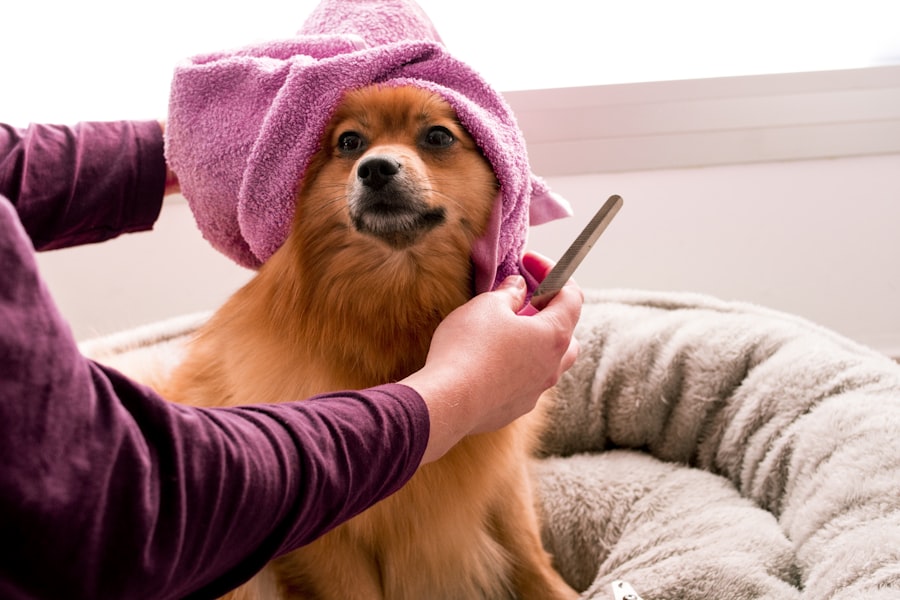
Quick answer: Grooming your dog at home requires five consistent routines — bathing, brushing, dental care, ear cleaning, and nail checks. Done regularly, these take under 30 minutes per week and directly support your dog's skin health, dental health, and overall wellbeing. The right products make each task faster, easier, and more comfortable for your dog — starting from $9.90 at Whisker House.
Key takeaways
✓80% of dogs over age 3 have some degree of dental disease — most owners never know until it is severe.
✓Most dogs need a full bath every 4 to 6 weeks — bathing more often risks stripping the coat's natural oils.
✓Brushing frequency depends on coat type — short coats weekly, long coats daily.
✓Ears need a weekly check — moisture and debris buildup leads to infection if left unaddressed.
✓The right shampoo matched to your dog's coat type makes a significant difference in results.
✓A complete at-home grooming kit from Whisker House starts from $9.90.
Professional grooming is valuable. But it happens every 6 to 8 weeks at best — and your dog's coat, teeth, ears, and skin need attention far more often than that. The owners who see the best long-term health outcomes for their dogs are the ones who treat grooming as a consistent weekly wellness habit, not an occasional appointment.
This guide walks you through every element of at-home dog grooming — what to do, how often, which products actually work, and the specific mistakes that turn a straightforward routine into a struggle.
Why home grooming is more than just aesthetics
In 2026, the dog grooming industry has shifted decisively toward what practitioners call wellness-focused grooming — routines that intentionally support skin health, coat condition, circulation, and emotional wellbeing, not just appearance. Groomers are seeing dogs more often than their veterinarians in many cases. The hands-on inspection that happens during grooming catches lumps, skin conditions, ear problems, and dental disease that owners would otherwise miss entirely.
When you groom your dog at home between professional appointments, you are doing the same thing — running your hands over their body, looking at their teeth, checking their ears, observing their skin. This regular handling is not just hygiene. It is preventative health monitoring that happens weekly instead of every two months.
There is also a bonding dimension that is easy to understate. Dogs who are regularly handled from a young age are calmer at the vet, more comfortable with strangers, and easier to manage in stressful situations. The grooming routine trains your dog to accept handling — one of the most practically useful things you can do for a dog's long-term temperament.
How often should you groom your dog?
Grooming frequency depends on coat type, breed, and which specific task you are talking about. Here is the honest, breed-informed guide:
| Task |
Short coat |
Medium coat |
Long coat |
| Full bath |
Every 6–8 weeks |
Every 4–6 weeks |
Every 3–4 weeks |
| Brushing |
Once a week |
2–3x per week |
Daily |
| Dental cleaning |
Daily is ideal — minimum 3x per week for all coat types |
| Ear check |
Weekly — clean when debris or smell is present |
| Nail check |
Every 2–3 weeks — trim when nails click on hard floors |
💡 The bathing frequency mistake most owners make
Bathing your dog too frequently is more common than bathing too infrequently. Dogs produce natural oils that protect their skin and coat. Bathing more than once every 3 to 4 weeks — unless your dog gets into something dirty — strips these oils and leads to dry, itchy skin and a dull coat. When in doubt, brush between baths rather than bathing again.
Step 1 — Bathing your dog at home
Bathing is where most at-home groomers make the most mistakes — wrong water temperature, wrong shampoo, and rushing the process. Getting this right from the start makes every subsequent bath easier because your dog associates it with calm, positive handling rather than stress.
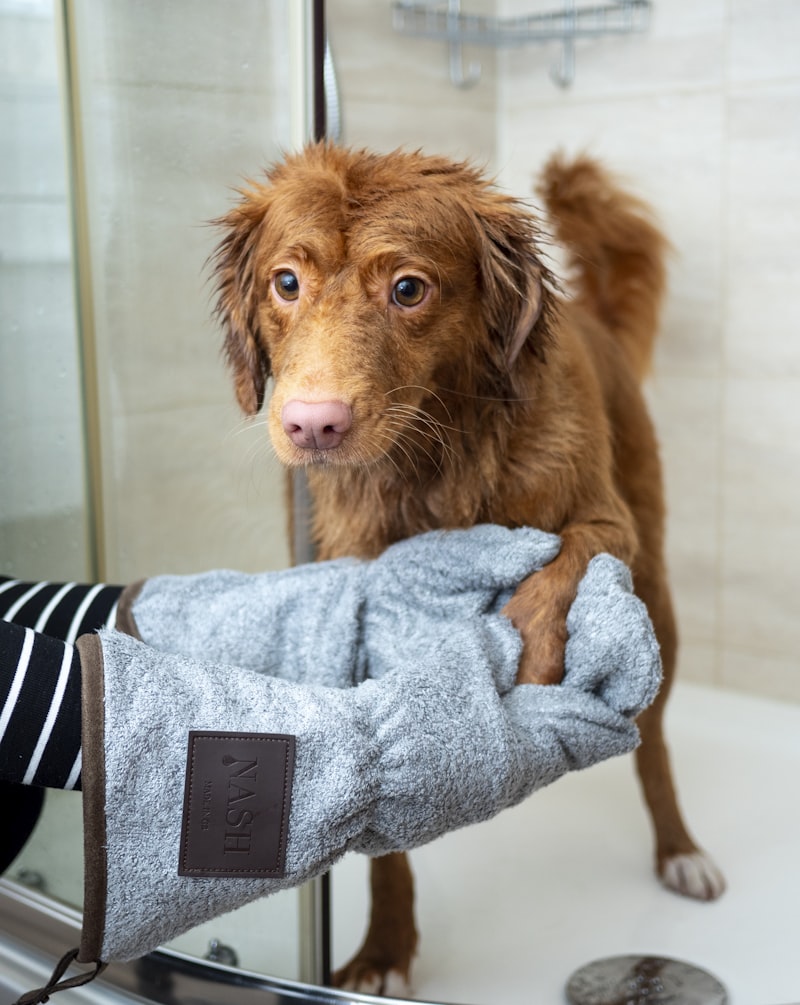 End the bath before your dog reaches the limit of their patience — a slightly shorter, calmer bath is always better than a longer, stressful one.
1
Brush before bathing
Mats and tangles tighten significantly when wet and become almost impossible to remove without cutting. Brush your dog's coat thoroughly before getting them wet — this removes loose fur, surface debris, and minor tangles before water locks them in place.
2
Use lukewarm water only
Dog skin is more sensitive than human skin. Water that feels comfortable to you may be too hot for your dog. Lukewarm — slightly warm, not hot — is correct. Test on your wrist before your dog steps in. Use lower water pressure than you would on yourself.
3
Choose the right shampoo for your dog's coat type
Not all dogs need the same shampoo. Heavy shedders need a deshedding formula that loosens the undercoat. Dogs with sensitive skin need a hypoallergenic, fragrance-free formula. Doodles and curly-coat breeds need hydrating, detangling formulas. Using the wrong shampoo — or human shampoo, which is formulated for the wrong pH — reduces results and can cause dryness and irritation.
4
Lather from neck to tail — avoid eyes and ears
Apply shampoo starting behind the neck and working toward the tail. Use a damp washcloth for the face and around the ears. Let a conditioning shampoo sit for 2 to 3 minutes before rinsing to allow the active ingredients to work.
5
Rinse completely
Residual shampoo is one of the most common causes of post-bath itching and skin irritation. Rinse until the water runs completely clear. Pay attention to the underarms, groin, and between the toes where shampoo collects.
6
Apply conditioner or leave-in spray after rinsing
A rinse-out conditioner restores moisture after shampooing. A leave-in spray applied after towel drying adds detangling, softness, and shine without weighing the coat down. Both steps are optional for short coats — highly recommended for medium and long coats.
7
Towel dry then air dry or low-heat blow dry
Press the towel against the coat rather than rubbing — rubbing creates friction that tangles and damages the coat. If using a blow dryer, use the lowest heat setting and keep it moving constantly. High heat damages both coat and skin.
💡 Between-bath freshness without water
For quick freshening between full baths — after a walk, before guests arrive, or whenever your dog needs a refresh without a full wash — a silicone bath brush used dry loosens debris from the coat surface and distributes natural oils. A quick finish with a signature coat spray keeps your dog smelling fresh for days without disrupting the skin's natural oil balance.
Step 2 — Brushing and coat care
Brushing is the highest-return grooming habit for most dog owners. It addresses loose fur, matting prevention, skin stimulation, early detection of lumps or skin conditions, and bonding — all in one session. It also has the most variation based on coat type.
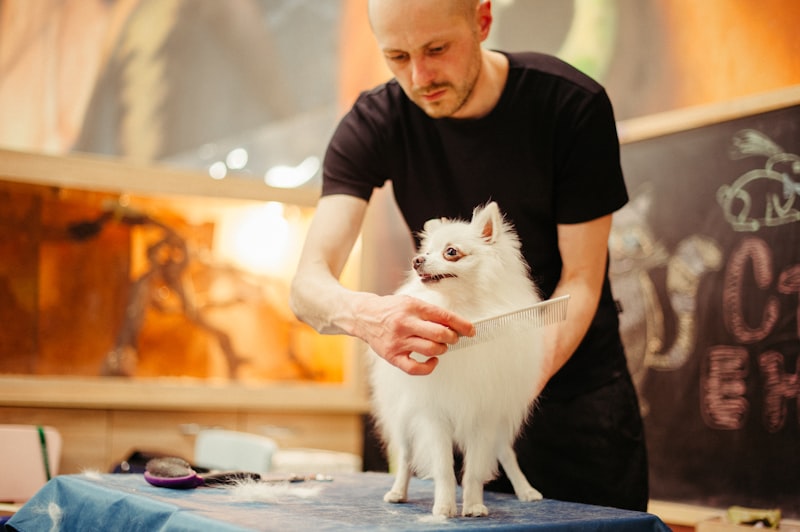 Brushing distributes natural oils through the coat and stimulates skin circulation — it is as much about health as it is about appearance.
Short coats (Beagles, Labradors, Boxers)
Once weekly with a rubber curry brush or silicone grooming brush. Short-coated dogs shed significantly despite having minimal visible coat — weekly brushing dramatically reduces fur on your furniture. The PRIDE+GROOM Bath Brush works equally well dry for quick debriefing between baths and wet during bath time for deep lather and loose fur removal.
Medium coats (Golden Retrievers, Border Collies, Spaniels)
Two to three times per week with a slicker brush, followed by a metal comb through the undercoat. These breeds have a double coat that traps shed fur inside rather than releasing it naturally. Without regular brushing, this creates mats that become painful and require shaving. A deshedding shampoo at bath time dramatically reduces the loose undercoat before it becomes tangled.
Long coats and Doodles (Shih Tzus, Maltese, Goldendoodles)
Daily brushing is not optional for long-coated and curly-coat breeds — it is the minimum maintenance their coat requires. Use a leave-in detangling spray before brushing if the coat has any tangles. Section the coat into small portions and work from the tips up toward the roots rather than pulling through from root to tip, which causes breakage and pain.
⚠ Never brush a completely dry, matted coat
Dry matted fur is painful to brush through and damages the coat. Apply a small amount of leave-in conditioning spray to the mat and wait 2 to 3 minutes before working it out with your fingers first, then a wide-tooth comb, then a slicker brush. If a mat is tight against the skin, take your dog to a professional groomer rather than attempting to pull through it.
Step 3 — Dental care at home
This is the most neglected component of dog grooming and the one with the most significant health consequences. Periodontal disease in dogs starts with plaque — a soft bacterial film that forms on teeth within hours of eating. Left to accumulate, plaque mineralizes into tartar within 3 to 5 days. Tartar cannot be removed at home — it requires professional scaling under anaesthetic. The bacteria in advanced tartar enter the bloodstream and have been linked to heart, kidney, and liver disease in dogs.
Consistent home dental care dramatically slows this progression. You do not need to achieve a perfect clean every time — you need to consistently disrupt the plaque before it mineralizes.
 Regular dental care at home is the single most impactful grooming habit for your dog's long-term health — it matters far more than most owners realise.
The easiest method: dental finger wipes
For dogs who resist toothbrushes — which is most dogs initially — dental finger wipes are the most accessible starting point. Slip the wipe over your index finger, lift your dog's lip, and rub along the gumline and tooth surfaces in small circular motions. It takes under 60 seconds and most dogs tolerate it far better than a toothbrush because the touch is gentler and more familiar.
Progressing to a toothbrush
Once your dog is comfortable with finger wipe handling, transitioning to a toothbrush gives better access to the back molars where tartar accumulates most rapidly. Start by simply touching the toothbrush to your dog's lips without brushing — reward calm acceptance. Progress to touching teeth, then gentle brushing motion on outer surfaces, then full brushing over several sessions.
💡 Never use human toothpaste on dogs
Human toothpaste contains fluoride and xylitol, both of which are toxic to dogs. Use only dog-specific toothpaste or the enzyme formula on dental wipes. Dog toothpaste is designed to be swallowed — dogs cannot rinse and spit — so the formula must be completely safe for ingestion.
Step 4 — Ear cleaning
A dog's ear canal is L-shaped — it runs downward before turning horizontal toward the eardrum. This shape traps moisture, debris, and bacteria more easily than the relatively straight human ear canal. Left unchecked, this buildup leads to otitis externa — ear infection — one of the top five reasons dogs visit the vet.
Check your dog's ears weekly. A healthy ear is pale pink inside, free of debris, and has no noticeable odor. Signs of a developing problem include brown or black discharge, visible debris, odor, redness, swelling, or your dog shaking their head or scratching at their ears.
1
Inspect before cleaning
Gently fold the ear flap back and look into the canal. If you see significant discharge, strong odor, redness, or swelling, do not clean — take your dog to the vet. These signs indicate active infection requiring medical treatment, not cleaning.
2
Apply a dog-specific ear cleaner
Never use water, hydrogen peroxide, or alcohol in a dog's ear. Use a commercially available dog ear cleaning solution — apply a few drops into the canal.
3
Massage the base of the ear for 20 to 30 seconds
Fold the ear flap down and gently massage the base — you will hear a squishing sound as the solution moves through the canal and loosens debris.
4
Let your dog shake, then wipe the outer canal
Step back and let your dog shake their head — this brings loosened debris up. Use a cotton ball or gauze pad to wipe the outer canal and visible folds. Never insert a cotton swab into the ear canal — this pushes debris deeper and risks damaging the eardrum.
Step 5 — Nail checks
Overgrown nails affect your dog's posture and gait. When nails grow long enough to touch the floor when standing, the force pushes the nail back into the toe — altering the angle of the toe, foot, and eventually the leg and spine. Long-term nail neglect is a direct contributor to joint problems in older dogs.
The check is simple: if you can hear your dog's nails clicking on a hard floor when they walk, the nails are too long. Trim until the click disappears.
💡 If you are nervous about cutting nails
The quick — the blood vessel inside the nail — recedes as you trim regularly. On white or clear nails, you can see the quick as a pinkish center and stop before reaching it. On black nails, trim small amounts at a time and watch for a small dark dot appearing in the center of the cross-section — this signals you are approaching the quick. When in doubt, trim less and trim more often. Your vet or groomer can demonstrate the technique on the first visit.
Grooming products at Whisker House
Every product below is verified in stock and chosen because it directly addresses a specific need covered in this guide. All PRIDE+GROOM products are professional-grade, sulfate-free, and pH-balanced for dog skin:
PRIDE+GROOM THE SHEDDER Dog Shampoo
from $20 (16oz) · $120 (1 Gallon)
Best for heavy shedders
Premium deshedding shampoo that loosens and releases the undercoat during bath time — reducing shedding at the source rather than just brushing it out later. Moisturizing, hypoallergenic formula. Ideal for Labs, Shepherds, Huskies, and double-coated breeds. Sulfate-free.
Shop THE SHEDDER — from $20 →
PRIDE+GROOM THE SENSITIVE ONE Dog Shampoo
from $20 (12oz) · $32 (16oz)
Best for sensitive or dry skin
Soothing hypoallergenic shampoo formulated for dogs with sensitive, itchy, or dry skin — and safe for puppies. Calms irritation, restores the skin barrier, and leaves the coat soft without artificial fragrance. The most widely applicable shampoo in the PRIDE+GROOM range.
Shop THE SENSITIVE ONE — from $20 →
PRIDE+GROOM THE NON SHEDDER Dog Shampoo
from $20 (12oz) · $120 (1 Gallon)
Best for Doodles and curly coats
Hydrating, smoothing, and detangling shampoo specially formulated for Doodles, Poodles, and curly-coat breeds. Reduces frizz, prevents matting, and leaves the coat manageable and soft. The 12oz size is the best-stocked variant with 4,857 units available.
Shop THE NON SHEDDER — from $20 →
PRIDE+GROOM THE FINAL COAT Dog Conditioner
from $20 (12oz) · $32 (16oz)
Best rinse-out conditioner
Softening, shine-inducing, detangling rinse-out conditioner. Applied after shampooing, it restores moisture, smooths the cuticle, and makes brushing effortless. Pairs with any PRIDE+GROOM shampoo. Essential for medium and long-coat breeds. 524 units in stock.
Shop THE FINAL COAT — from $20 →
PRIDE+GROOM THE LEAVE IN Conditioner
$25
Best for detangling between baths
Reparative leave-in conditioner spray that detangles, softens, and adds shine without rinsing. Spray onto the coat after towel drying or between baths before brushing. Prevents breakage and makes every brush session faster and more comfortable. 3,168 units in stock.
Shop THE LEAVE IN — $25 →
PRIDE+GROOM THE BATH BRUSH
$22
Best silicone grooming brush
Premium silicone bath brush designed for deshedding, lather distribution, and massage during bath time. Soft flexible bristles reach through the coat to the skin without scratching. Also works dry for quick debriefing between baths. 89 units in stock.
Shop THE BATH BRUSH — $22 →
PRIDE+GROOM THE BALM Paw & Nose Balm
$23
Best for paw and nose care
Healing balm for dogs and cats that soothes dry, cracked paw pads and noses. Natural, hypoallergenic formula absorbs quickly without leaving a greasy residue. Apply after walks, especially in summer heat or winter cold when pads are most vulnerable. 350 units in stock.
Shop THE BALM — $23 →
PRIDE+GROOM PROUD Signature Scent Spray
$26
Best for between-bath freshness
Refreshing deodorizing coat spray that keeps your dog smelling fresh between baths without disrupting the skin's natural balance. Spray lightly over the coat and brush through. Suitable for dogs and cats. 1,549 units in stock — the most available PRIDE+GROOM product.
Shop PROUD Scent Spray — $26 →
💡 Best value — THE BATH BOX SET
The PRIDE+GROOM Bath Box Set ($62) bundles the right shampoo with THE FINAL COAT conditioner in one purchase — available in THE SHEDDER, THE NON SHEDDER, and THE SENSITIVE ONE variants. Saves $10 versus buying separately and gives you the complete two-step bath routine in one box. 1,804 units in stock across all three variants.
Shop THE BATH BOX SET — $62 →
Also recommended — dental care essentials:
Dr. Milou Pet Dental Finger Wipes
from $10.95
Best for daily dental care
Enzyme-based formula on a finger-fit wipe. Disrupts plaque before it mineralizes into tartar. Most dogs tolerate this far better than a toothbrush. Available in 10-wipe and 20-wipe packs for dogs and cats.
Shop Dental Wipes — from $10.95 →
Dr. Milou Replacement Brush Heads (2 Pack)
$9.90
Best value dental care
Replacement heads for the Dr. Milou electric pet toothbrush. Oscillating bristles reach between teeth more effectively than manual brushing. Replace every 2 to 3 months. 16 units in stock — most available dental product at Whisker House.
Shop Brush Heads — $9.90 →
Myths vs. facts about dog grooming
MythYou can use baby shampoo on dogs — it is gentle enough.
FactBaby shampoo is formulated for human skin pH (4.5–5.5). Dog skin pH is more alkaline (6.2–7.4). Using baby shampoo disrupts the skin's protective barrier, leading to dryness and irritation. Always use a dog-specific formula — PRIDE+GROOM products are formulated to the correct pH for every coat type.
MythOne shampoo works for all dogs.
FactCoat type and skin condition are the two most important variables in shampoo selection. A deshedding shampoo is counterproductive for a Doodle's curly coat. A hydrating shampoo for curly coats will not address the undercoat of a Husky. Matching the shampoo to the coat type delivers dramatically better results in coat condition and reduced shedding.
MythIf my dog's teeth look okay, they do not need dental care.
FactPeriodontal disease develops below the gumline where it is invisible externally until it is severe. By the time your dog has visible tartar, bad breath, and apparent discomfort, significant bone and tissue loss has already occurred. Daily dental care prevents the underlying disease, not just the visible symptoms.
MythShaving my double-coated dog in summer keeps them cool.
FactDouble coats insulate against both cold and heat. The undercoat traps air that acts as thermal regulation — shaving removes this protection and exposes skin directly to UV radiation. Dogs with shaved double coats often experience more discomfort in summer heat, not less. Brush out the undercoat regularly to allow airflow instead.
MythHome grooming is only for saving money — it is not as effective as professional grooming.
FactHome grooming and professional grooming serve different purposes. Professional grooming provides haircuts, deep cleaning, and professional tools. Home grooming provides consistent weekly maintenance, health monitoring, and the behavioral benefits of regular handling. Using professional-grade products like PRIDE+GROOM at home closes the quality gap significantly.
Frequently asked questions
Which PRIDE+GROOM shampoo is right for my dog?
Choose based on your dog's primary coat concern. If your dog sheds heavily — Labs, Shepherds, Huskies, Retrievers — choose THE SHEDDER. If your dog has sensitive, itchy, or dry skin, or is a puppy, choose THE SENSITIVE ONE. If your dog is a Doodle, Poodle, or curly-coat breed, choose THE NON SHEDDER. If you are unsure, THE SENSITIVE ONE is the most universally applicable formula and is safe for all coat types and ages.
How often should I bathe my dog?
Most dogs do well with a full bath every 4 to 6 weeks. Short-coated dogs can go 6 to 8 weeks between baths. Long-coated dogs may need bathing every 3 to 4 weeks to prevent matting. Dogs who swim regularly or spend time outdoors in mud may need bathing more often. Bathing more than once every 3 weeks without a specific reason risks stripping the coat's natural oils.
How do I groom a dog that hates being groomed?
Start with the least invasive part of the routine — usually brushing — and keep sessions very short (2 to 3 minutes) with immediate rewards for calm behavior. End every session before the dog becomes stressed. Gradually increase duration over multiple sessions as the dog learns the routine is safe. Most dogs who were difficult to groom as adults become significantly easier within 4 to 6 weeks of consistent, positive short sessions.
Can I use PRIDE+GROOM products on puppies?
THE SENSITIVE ONE Dog Shampoo is specifically noted as safe for puppies. It is hypoallergenic, fragrance-free, and formulated for gentle skin. The leave-in conditioner and bath brush are also safe for puppies once they are comfortable being handled. Introduce grooming early and keep sessions calm and positive — puppies who learn to accept grooming at an early age are far easier to handle throughout their lives.
What is the difference between THE FINAL COAT conditioner and THE LEAVE IN conditioner?
THE FINAL COAT is a rinse-out conditioner applied during the bath after shampooing and rinsed off before drying — it restores moisture and smooths the coat immediately after washing. THE LEAVE IN is a spray conditioner applied after towel drying and left in the coat without rinsing — it detangles, prevents breakage during brushing, and adds ongoing softness between baths. Both can be used together for maximum coat conditioning results.
How do I reduce my dog's shedding at home?
Three things make the most measurable difference: regular brushing (3 to 4 times per week during shedding season), using THE SHEDDER deshedding shampoo at bath time to loosen the undercoat during the wash, and daily Omega-3 supplementation from fish oil to support skin health and reduce shedding driven by dry or inflamed skin. These three combined reduce shedding more effectively than any single approach.
Final recommendations
The 2026 grooming shift is clear: your dog deserves the same level of care and intention you put into your own wellness routine. That means consistent weekly habits, the right products for your dog's specific coat type, and treating grooming as preventative health care — not just aesthetics.
1
Choose the right shampoo for your dog's coat type. Shedding dog needs THE SHEDDER. Sensitive skin needs THE SENSITIVE ONE. Curly coat needs THE NON SHEDDER. One correct product change can transform bath results.
2
Add a conditioner to every bath. THE FINAL COAT rinse-out conditioner takes 2 extra minutes and makes a visible difference in coat softness and manageability from the first use. Pair with THE LEAVE IN spray for ongoing between-bath detangling.
3
Brush before every bath without exception. This single habit prevents the most common grooming problem — mats that tighten in water and become impossible to remove without cutting.
4
Start dental care this week. Begin with Dr. Milou dental finger wipes — 60 seconds per day. The enzyme formula starts disrupting plaque immediately even if your technique is imperfect. Your dog's vet will notice the difference at the next checkup.
5
Check ears every week. Weekly checks catch problems when they are easy to manage — monthly checks catch them after they have become infections requiring medication.
6
Keep every session calm and end on a positive note. A dog that accepts grooming willingly is infinitely easier to care for long-term. Invest in building that association with patience and rewards now — it pays off for the next 10 to 15 years.
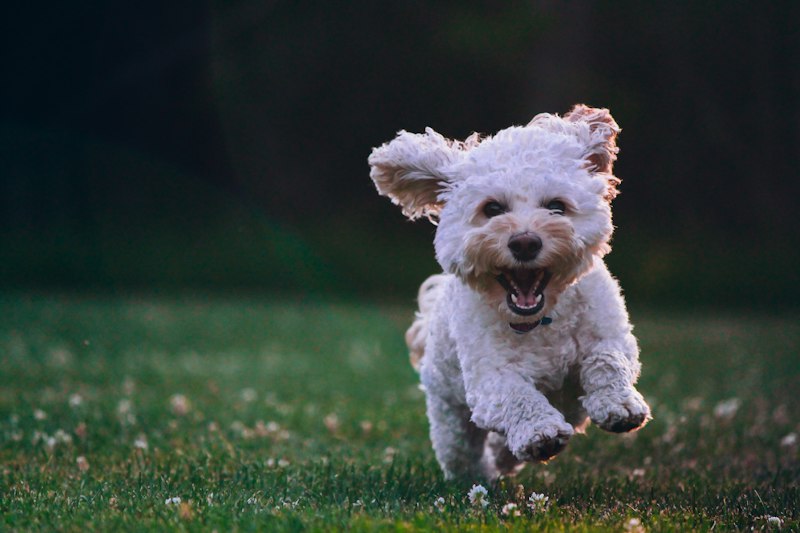 A well-groomed dog is not just clean — they are healthier, calmer, and easier to handle throughout their life.
Professional-grade grooming. At-home prices.
The full PRIDE+GROOM grooming range — shampoos, conditioners, bath brush, paw balm, and scent spray — plus Dr. Milou dental care, all in stock now at Whisker House. Ships across the United States from $9.90.
Shop dog grooming essentials at Whisker House →
WH
Whisker House
Whisker House is a curated pet supply store built by pet owners who believe your dog deserves the same level of care and intention you put into your own wellness routine. Every product is chosen because it solves a real problem for real pets. Backed by 780+ verified customer reviews, shipping across the United States at whiskerhouse.store.
